
The web, wired
into your local agent.
wigolo is a local-first server that hands any AI agent the whole web — search, fetch, crawl, extract, cache, and research. In your editor over MCP, in your framework through an SDK, or in your self-hosted stack over REST. No API keys. No cloud. No metered bill.
claude code · cursor · codex · gemini cli · vs code · windsurf · zed · antigravity · langchain · crewai · n8n — and any other agent, through MCP, REST, or the SDKs
Everything heavy runs on your machine
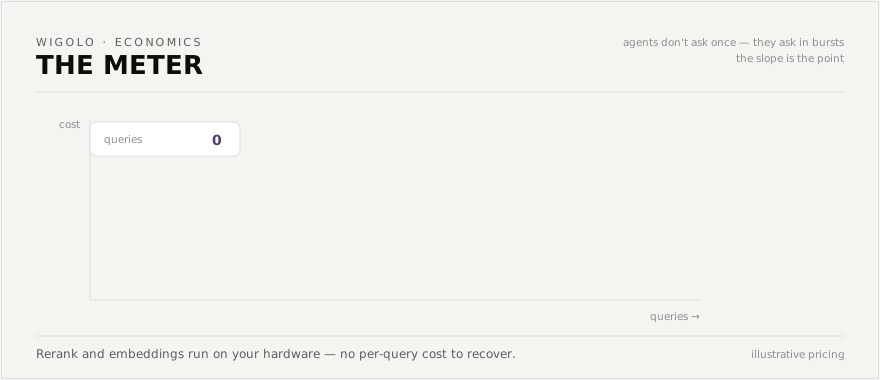
No metering, no round-trips you didn't ask for. Your agent reaches the open web through one local process — and the work that costs money elsewhere happens right here instead.
Spoken over MCP — and the same tools answer over a REST API and language SDKs, so anything that talks HTTP can drive it.
A tiered router that starts at plain HTTP and only escalates on what it actually sees — anti-bot challenges, empty SPA shells — never on a guess about the domain.
18 search-engine adapters fan out in parallel, then rank fusion and an on-device ML reranker settle the order — with an explainable score behind every single result.
Everything fetched lands in a local index — keyword search paired with on-device vectors. Re-asking is instant and free, and it still answers when you're offline.
~/.wigolo on your machine — no keys, nothing metered, and nothing leaves unless you opt into an LLM.one command wires it into
+ any other agent, through MCP
// every result explains itself
{
  "excerpt": "Logical replication replicates data…",
  "score": 0.87,
  "breakdown": {
    "semantic": 0.91,
    "lexical": 0.74,
    "engine_consensus": "4/5 engines"
  },
  "source_span": { "start": 1284, "end": 1571 },
  "citation_id": "f38b44c100e4"
}
Evidence, not blue links
See the receiptsOne MCP call fans a query array across many engines in parallel. Every result comes back with a transparent score breakdown, byte-offset source spans, and citation IDs — output your agent can quote.
↓ anti-bot challenge detected
↓ SPA shell · thin content
Routing on observable signals
How it worksThe keyless fetch ladder escalates to a real browser on what it sees — SPA markers, challenge bodies, thin content — not domain guesses. It clears most challenge sites with no keys; the strictest managed-challenge and IP-reputation walls need an opt-in proxy, solver, or reader. It learns per-domain, and unlearns when a site stops needing it.
agent → cache "postgres logical replication"
wigolo → 3 hits · hybrid keyword + semantic
   postgresql.org/docs/current/logical-replication
   postgresql.org/docs/current/warm-standby
   wiki.postgresql.org/wiki/Streaming_Replication
latency → 3ms · $0 · nothing left your machine
Everything it sees, it keeps
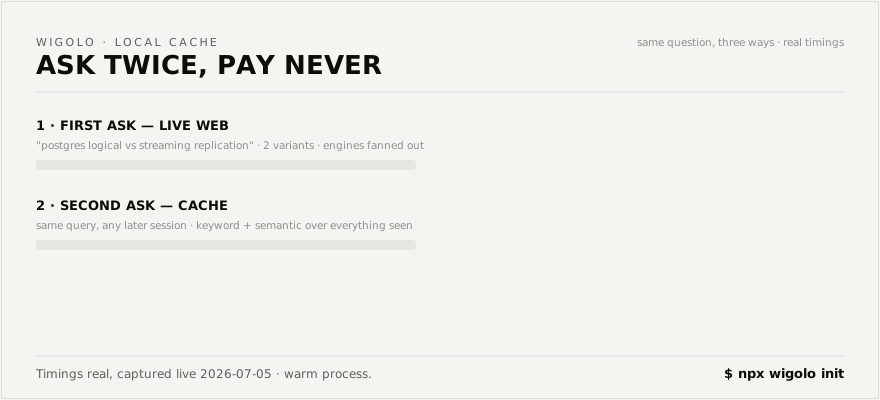
Get startedEvery response lands in a local store under ~/.wigolo/ — full text, keyword index, and on-device vectors. Asking again is instant and costs nothing; find_similar and change detection build on it.
question → "how does postgres logical replication work?"
decompose → 4 sub-queries · fanned out in parallel
   ▸ publication / subscription model
   ▸conflict handling & limitations
   ▸ vs. physical / streaming replication
synthesize → cited brief · 7 sources · 12 citations
gaps → surfaced, not hidden
Research that writes itself
All 10 toolsresearch decomposes a question, fans out sub-queries, fetches sources, and hands back a cited brief. agent runs an autonomous plan → search → fetch → extract → synthesize loop with a step log and time budget.
Free, and meant to
stay that way
wigolo is AGPL-3.0 — free to use, modify, and self-host, including inside a company. The license keeps it open: nobody can close it up and sell it back to you. Maintained, not paywalled.
Thank you
wigolo is free for everyone and stays that way. The sponsors below help keep it maintained, and their support goes straight into the work.

TestMu AI (formerly LambdaTest) is the world's first full-stack agentic AI quality engineering platform, trusted by 18,000+ enterprises.
Visit TestMu AI →
Want to support wigolo? Sponsorship keeps a free-forever project maintained, and there’s room for more companies and individuals alongside the sponsors above. If that sounds like you, write to ktowhid20@gmail.com — it goes straight to the developer who wrote the code.
“Verbatim quoted excerpts, pinned to byte-offset source spans with citation IDs.”
All four tools converged on the same core answer. wigolo · the only tool of four to return this
1 / 4Same fight.
Different physics.
The paid tools in this lane are genuinely good — that's what makes the parity interesting. What still separates wigolo isn't quality. It's where the work happens.
| wigolo | firecrawl | exa | tavily | |
|---|---|---|---|---|
| the fight — everyone shows up | ||||
| Multi-engine web search | ||||
| Fetch & structured extraction | ||||
| Whole-site crawl & map | — | |||
| the physics — where the work happens | ||||
| Verbatim excerpts pinned to byte-offset source spans | — | — | — | |
| Explainable per-result score decomposition | — | — | — | |
| Persistent local memory — instant, offline re-query | — | — | — | |
| Query data stays on your machine | — | — | — | |
| API key / account | none | required | required | required |
| Cost per query | $0 | metered | metered | metered |
Feature standing as of July 2026 — check each vendor's docs for current state. One cold query, four tools, judged on the evidence alone — watch the full run.
Give your agent the whole web.
One instant command wires the local engine into your agent — search, fetch, crawl, extract, cache, and research, with no API key.
Working in under two minutes.
Read the full CLI reference and docs on GitHubInstall & wire your agent
Auto-wires the agent for you — comma-separated: claude-code · cursor · codex · gemini-cli · opencode · vscode · windsurf · zed · antigravity. Using any other MCP client? Drop --agents — init still sets everything up and you point it at wigolo yourself. init does the full setup — downloads the browser engine + models and runs a health check so any problem surfaces here; add --no-warmup to defer downloads to first use.
That's the whole setup — search, fetch, crawl, extract & cache need no API key. Beyond MCP: a REST API, TypeScript & Python SDKs, an agent-skills installer, and framework integrations (LangChain, CrewAI, LlamaIndex, Vercel AI SDK).
Check it's healthy
Verifies the local engine — search, browser, on-device models.
Node ≥ 20 · macOS / Linux / Windows · no account, no key.
Optional — answer synthesis
research, agent, and answer-format search use an LLM. Easiest is a free Gemini key (no local setup). Set the provider plus its key — a provider alone isn't enough.
Grab a free key at aistudio.google.com. Prefer fully local & keyless? Run Ollama: export WIGOLO_LLM_PROVIDER=ollama WIGOLO_LLM_MODEL=llama3.1
Found something?
Say it.
wigolo is in public beta — everything shipped works, and it's held to a 6,000-test suite, but beta means the polish is still being sanded. Every report is read, usually the same day.